

written by Natasha Kaniel-Shears
The Japanese language is one of the hardest for English speakers to learn, and starting to learn it can seem quite intimidating at first. However, by learning just a few basic phrases, you are already ahead of most people!
Whether you are just starting out learning or are planning on visiting Japan soon, many basic phrases can help you out, whether that’s at a restaurant, cafe, or a convenience store.
For many tourists, Google Translate and a few gestures are enough to navigate a foreign country – technology has made the world impressively accessible. However, knowing the basics without needing to rely on said technology for the simple daily interactions will not only feel rewarding but also come across as respectful for the locals!
Throughout this article, we will teach you not only the meaning of the key phrases but also in which context they are best used and the customs around them. With just a little effort and practice, visitors to Japan can pick up a few key phrases to navigate restaurants, temples, shops, and daily life.
What’s the Point
Respect!
The effort to learn even a few simple phrases can go a long way toward showing a little respect for the people and place you are visiting. Locals appreciate it when they see others making an effort to learn and speak the local language.
Learning!
Aside from the fun of learning another language in general, learning just a bit about the Japanese language can help you understand Japanese culture better as well. For example, many basic Japanese phrases are deeply ingrained with the well-known Japanese courtesy and humility, so learning about the language will also help visitors become a little more familiar with the culture.
Fun!
Being able to communicate with someone in their native language is simply fun. Not only does it provide a fun new party trick, but it also opens the door to meeting new people and discovering new experiences.
Four Golden Phrases for Tourists in Japan
There are a few Japanese phrases that anyone visiting Japan should try to learn. These phrases are used constantly in restaurants, shops, and daily life, and learning them can help visitors exercise a bit more courtesy while navigating Japan.
Sumimasen
Generally translated as “excuse me,” this is the golden word for getting someone’s attention. If you’re ready to order in a restaurant, don’t be afraid to say a confident “sumimasen” when you need the waiter’s attention. If you’re lost in a train station, give a quick “sumimasen” to station staff before asking for directions. ‘Sumimasen’ can also pass for a polite apology if you bump into someone in a crowd or need to weasel your way out of a packed train car. Honestly, ‘Sumimasen’ is a great thing to say in any confusing situation to show respect for the other person.
Arigatou gozaimasu
A polite, general ‘thank you’ can be used in any context to express thanks. A good ‘Arigatou gozaimasu’ and a polite nod of the head will get you far in everyday conversations. Think of the pronunciation as simply removing the final ‘u’ sounds from the words.
Onegaishimasu
This word implies a polite request. It can be used to order food (karaage, onegai shimasu) or for other general requests. For example, if you see something you’d like to buy, perhaps an omamori at a shrine, point to your desired souvenir, say “onegaishimasu,” and congratulations, you are now more polite than 95% of tourists in Japan (disclaimer: this percentage may be inflated).
Follow it up with an “Arigatou gozaimasu,” and the number rises to at least 97% (disclaimer: this percentage may also be inflated). You can also use “Onegaishimasu” to say “yes, thank you”. For example, in a store when they ask if you need a bag, and you do, just say “Onegaishimasu”, “please”, or “Hai onegaishimasu”, “Yes please” to get the message across that you do indeed need a bag.
Daijoubu desu
“Daijoubu desu” is a one-size-fits-all kind of phrase meaning something like “It’s okay.” If you’re using your eco bag at the konbini and the staff offers a bag, you can say “daijoubu desu,” “that’s okay.” If someone in customer service asks you if you need a receipt and you don’t, hit them with a “daijoubu desu”. Just try not to say “daijoubu desu” when they ask you to pay for something, that might end badly.
Hello and Goodbye
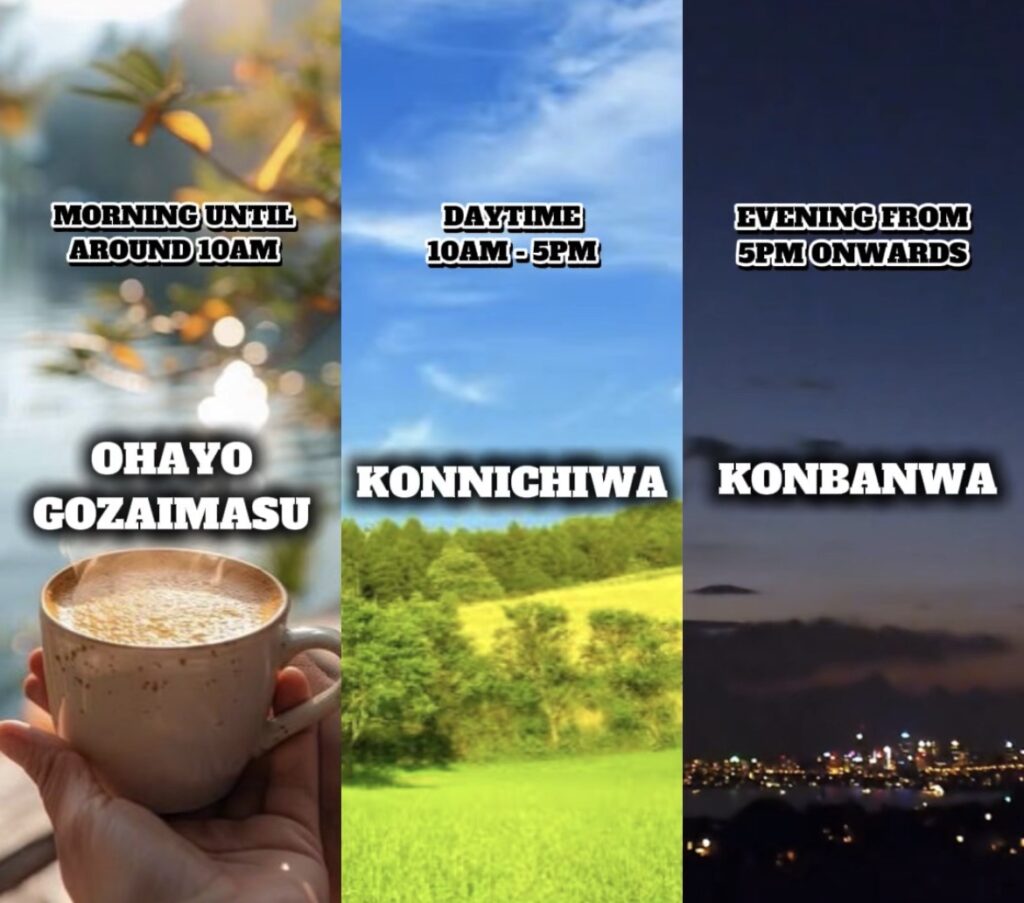
Ohayo gozaimasu
“Ohayo gozaimasu,” “good morning” is the polite way to say good morning! This one you’ll hear and say often in the morning hours (if you’re up and running early in the morning). More casually among acquaintances, simply “Ohayo” will do just fine as well.
Konnichiwa
“Konnichiwa,” “good day” is the all-purpose daytime greeting. If it’s light outside and you’ve lost all concept of time and space while shopping in the local shopping district, “konnichiwa” is impossible to mess up.
Konbanwa
In the evening, when the sun has gone down, and you’re getting late-night snacks from your local konbini, “Konbanwa,” “Good evening” is the way to go. Saying “Konnichiwa” works as well, but saying “Konbanwa” earns you imaginary local points.
Kiotsukete
“Kiotsukete” translates to “be careful” or “take care” in English. This is used when parting ways with someone. It’s polite, widely acceptable, and a great way to show you care without being overly formal.
Advanced Phrases for Daily Interaction
Wakarimasen
“Wakarimasen” literally means “I don’t understand”. Maybe you’re trying out your Japanese at a grocery store and suffer from success when the employee asks you a difficult question you don’t understand. Wakarimasen, paired with the word from earlier “Sumimasen” (“sorry”), is a great way to navigate that situation. “Sumimasen, wakarimasen,” and the other person will usually switch to gestures or simpler words to help you out.
Gomenasai
“Gomenasai,” “sorry” is another form of apology you can hear among Japanese people. However, “Gomenasai” is more commonly used among friends or family. In public, when conversing with strangers, for example, customer service employees stay with “Sumimasen” from earlier to be polite and more formal.
Here is a short video to explain the differences between “Sumimasen” and “Gomenasai”:
Eigo o hanashimasu ka?
This phrase means “Do you speak English?” and is extremely useful when you’ve reached the limit of your Japanese knowledge. The phrase signals that you’re trying before defaulting to English and not automatically expecting them to speak English, which people appreciate. People are more likely to want to help you out in English to the best of their abilities when you first show that you’re trying to do the same.
Advanced Phrases for Eating Out
Tennai de / Omochikaeri de
Tennai de = for here
Omochikaeri de = for takeaway
When the staff asks “Tennai desu ka? Omochikaeri desu ka?”, simply repeat which option you’re going for.
“Tennai desu ka?” “For here?”
“Omochikaeri de” “For takeaway”
And boom! You’ve levelled up to a fluent coffee orderer.
Hitori desu / Futari desu
Numbers! In Japanese, different objects are counted differently and for people, the counting goes as follows:
Hitori = One person
Futari = Two people
Sannin = Three people
For people with even more friends you can find the full list here: https://garrett-sensei.weebly.com/counting-people.html
When going to a restaurant, this comes in handy to tell the waiter how many people are in your party. Speaking of handy, of course you can signal with your hands how many people there are, but speaking it out loud in Japanese definitely gains you some brownie points.
Itadakimasu
“Itadakimasu” is a phrase said before eating a meal. It loosely translates to “I humbly accept”, showing appreciation for the food and the people who made the food. This isn’t a rule set in stone; you won’t get in trouble for not saying “Itadakimasu” but it’s a polite and fun way to connect with the culture and a phrase you might hear out and about in Japan.
Gochisousama deshita
This one is a mouthful for sure, but definitely worth learning. This phrase translates to “Thank you for the meal” and is a very polite thing to say to show appreciation to whoever prepared or served your food. Speaking of brownie points, this phrase is a very commonly said phrase that will show the locals that you’ve put in effort to learn about their customs and common phrases. For the monstrous pronunciation, here is a little guide video:
Konbini special!
Almost everybody in Japan, whether resident or tourist, goes to convenience stores for daily snacks and amenities, or even to pay bills. No matter where you are in Japan, there will be a konbini just around the corner!
Now the interactions within the konbini are actually quite straightforward and often the same, you only need to listen out for some key words and you will understand the cashier without a problem!
Irasshaimase!
This is not necessarily limited to konbinis, but most places where retail and customer service are present, you will be greeted with ‘Irasshaimase’. Simply, it means ‘Welcome, come in’. Most Japanese people tend not respond to the greeting as this is quite normal, so for this one, no response is necessary to learn!
At The Cashier
Now, when arriving at the cashier with whichever goodies you bought, you might hear a few different phrases. Usually, you only need to respond with Yes, please or No, that’s okay. Which in Japanese is ‘Hai, onegaishimasu’ (Yes, please) or ‘daijoubu desu’ (No, that’s okay).
Point card
Most of the time, they will ask you if you have a point card, and they will generally ask ‘Pointo kādo wa omochi desuka?’ Since point card and pointo kādo are so close to each other in sound, it should be easier to understand what they are asking.
Plastic bag
The staff will ask you if you want a plastic bag. There are a few ways they might ask this, but the most common way is ‘Fukuro wa irimasu ka?’. They might phrase it in a few different ways but the keyword here to listen to is ‘Fukuro’, which means plastic bag in Japanese. They might also use the word ‘kaban’, however, this is a tad rarer in konbinis as kaban is used more for bags that are not one-time uses like plastic bags.
Payment
When it comes to paying, they will be asking ‘Oshiharai hōhō wa?’ which translates to ‘How would you like to pay?’. They might also just say how much your total is, which is number+en (Yen in Japanese is simply En).
Here are responses with some different payment options:
- Genkin de: Cash
- Kādo de: Credit card
- Kōtsūkei IC de: IC Card
After paying they will ask if you want your receipt by saying ‘Reshīto wa yoroshii desuka?’ which translates to ‘Do you want a receipt?’ Which a simple Yes or No suffices as an answer.
After this both parties will thank each other with a classic ‘arigato gozaimasu’, and BOOM! You are now ready for most konbini interactions you will face in Japan!